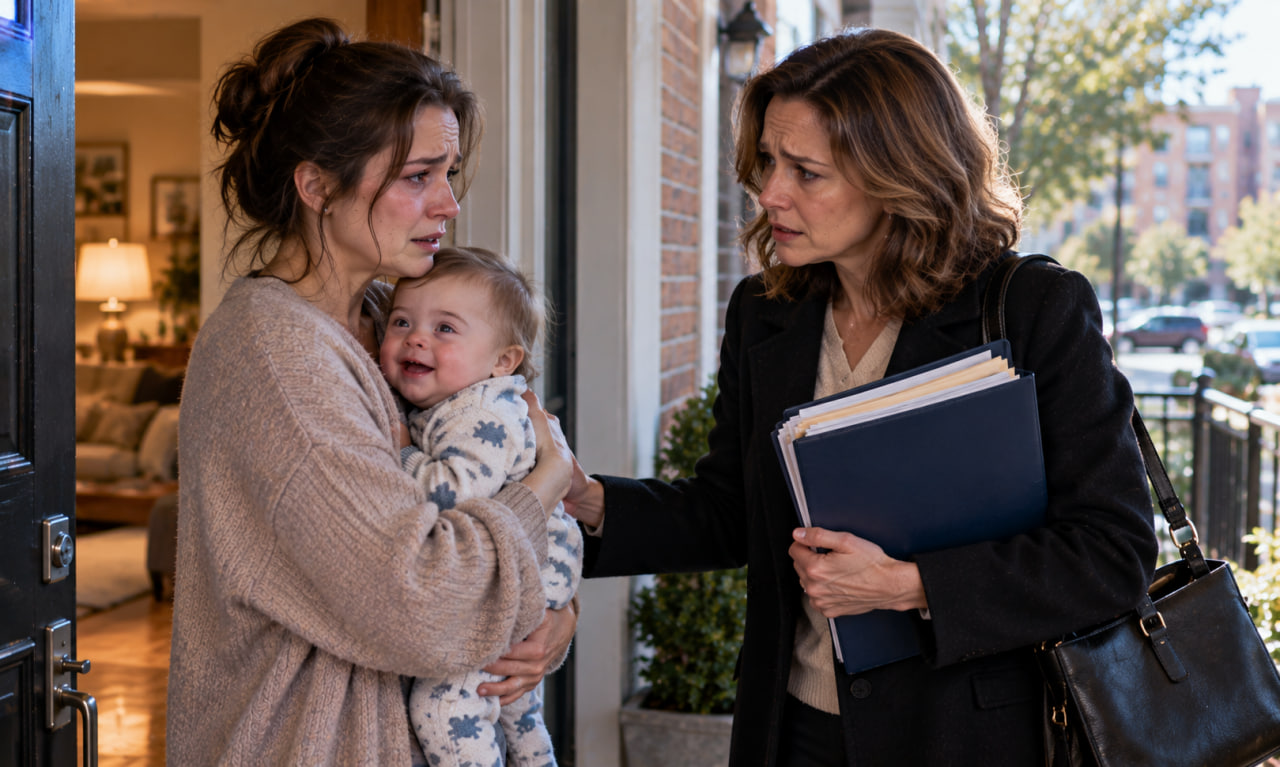
“My first son was born eight years ago.”
I frowned.
Julian had never mentioned another child.
“His name was Elias.”
She pulled out a photograph of a newborn.
“Elias had Down syndrome.”
Every hair on my arms rose.
Claire continued.
Elias had developed severe respiratory complications hours after birth.
Doctors decided he needed to be transferred to a specialized neonatal center.
At the same time, Claire suffered a major postpartum hemorrhage.
She was rushed into emergency surgery.
Julian, as Elias’s father, authorized the emergency medical transfer while she was unconscious.
“When I woke up the next day,” Claire said, “Julian told me Elias had gone into cardiac arrest after the transfer.”
“He told you he died?”
She nodded.
Julian’s mother, Margaret, took over everything while Claire recovered.
Calls to doctors.
Paperwork.
A private memorial.
Claire received a hospital memory box containing Elias’s footprint card, photographs, and a blanket.
Julian showed her copies of medical documents supposedly confirming his death.
There was no viewing.
No body.
Claire had nearly died herself and was heavily medicated.
“I trusted my husband,” she said. “And I trusted his mother. I thought they were protecting me while I was recovering.”
For eight years, she believed Elias was dead.
Then Julian’s father died.
During probate, the estate attorney requested certified documentation concerning all of Julian’s living and deceased children because of a family trust.
Claire requested Elias’s official death certificate.
The state told her no such certificate existed.
“At first, I assumed it was a filing mistake.”
She questioned Julian.
He became furious.
He told her grief had distorted her memory.
He said she had always struggled to accept Elias’s death.
So Claire hired a private investigator.
The investigator confirmed something impossible.
Elias had been legally transferred from the neonatal center.
There was no record of his death there.
Days later, someone had signed paperwork authorizing his placement within a private organization that operated medical foster homes and specialized residential programs for children with complex developmental needs.
The authorization supposedly carried Claire’s signature.
She had never signed it.
“What happened to him?” I whispered.
Claire pulled another photograph from the folder.
A boy around eight sat beside a window holding colored pencils.
Dark hair.
Round cheeks.
A cautious little smile.
“That’s Elias.”
I stared at her.
“He’s alive?”
She nodded.
Her voice disappeared.
“Yes.”
The investigator had traced the organization through a series of payments made by one of the Sterling family’s holding companies.
Quarterly transfers had continued for nearly eight years.
The payments were disguised as charitable educational grants.
Eventually, the investigator located a former employee who remembered a baby arriving from Seattle under unusual privacy instructions.
The child’s surname was later changed.
Elias had spent his early years with a medically trained foster family before moving into another supported home operated by the same network.
“I mourned a living child for eight years.”
I looked down at Milo.
Suddenly Julian’s words felt much darker.
“You think he’s going to try this with Milo?”
Claire looked directly at me.
“I don’t know.”
Then she glanced at the messages again.
“But I’m afraid he might.”
My phone buzzed.
Unknown number.
“You two need to stop talking.”
Claire went pale.
Another message arrived.
“Maya, think carefully about what’s best for Milo.”
I felt my stomach drop.
Claire stood immediately.
“Now I’m sure.”
This time, neither of us confronted Julian.
Claire called her attorney, Diana Price, and the private investigator who had been helping her.



One Comment on “I Told My Married Boyfriend’s Wife About Our Baby and Expected Her to Hate Me—3 Mornings Later, She Knocked on My Door”