At 6:12 on the morning Harper banned me from Christmas, I was standing in my kitchen in slippers, shaking cinnamon over two bowls of popcorn.
Emma liked hers with white chocolate drizzled over the top. Noah wanted plain caramel because he said chocolate “tasted like old crayons.” Lily, who was six and still believed the moon followed our car because it loved her, had requested purple pajamas instead of pink.
I had written every preference down in my little red notebook.
Emma—cinnamon popcorn. Noah—cut tags from shirts. Lily—purple, not pink.
It was the kind of notebook grandmothers keep when love becomes too large to trust to memory.
The phone rang while I was tying gold ribbon around the gift bags.
“Hi, Harper,” I said brightly.
My daughter-in-law did not answer right away.
That should have warned me.
Harper was never quiet unless she was arranging something.
Finally, she said, “We think it would be healthier if you didn’t come this year.”
My hands stopped over a package of dinosaur socks.
“What does that mean?”
“It means,” she said carefully, “that you ask questions. You have opinions. It creates tension. Alex and I want a peaceful Christmas.”
Across the room sat my late husband Martin’s empty armchair.
Every Christmas morning, he had claimed that chair with coffee in one hand and wrapping paper stuck to his socks. He would pretend not to cry when the children opened their gifts, then vanish into the hallway to blow his nose loudly enough for everyone to hear.
He had been dead for eighteen months.
The chair still faced the tree.
For one humiliating second, I nearly begged.
I nearly promised Harper I would be useful, grateful, silent.
Invisible.
Instead, I asked one question.
“Does Alex agree with this?”
There was a pause.
Small.
But long enough to hurt.
“Yes,” she said.
“All right.”
Then I hung up.
I sat at the kitchen table for ten minutes without moving. The popcorn cooled. The ribbon curled around my fingers. Somewhere outside, a snowplow scraped along the street, its blade grinding against ice like something trying to claw its way out of the earth.
Then I opened my laptop.
And I started canceling everything attached to my name.
The mountain rental house went first.
Then the catered Christmas Eve dinner, the florist, desserts, linens, wine delivery, transportation, matching pajamas, and the photographer Harper had hired for what she called “natural family memories.”
There was nothing natural about spending $11,640 to manufacture a perfect Christmas for people who had decided I was inconvenient.
Every cheerful confirmation email became a cancellation notice.
Every deposit became a refund request.
Every “We look forward to celebrating with you!” became a little less painful.
Twenty minutes after the final cancellation, Harper called again.
Her voice had changed.
“Alex and I need to stop by for a calm conversation.”
“Of course,” I said.
I made tea.
Not because I wanted to be gracious.
Because I wanted my hands occupied when they arrived.
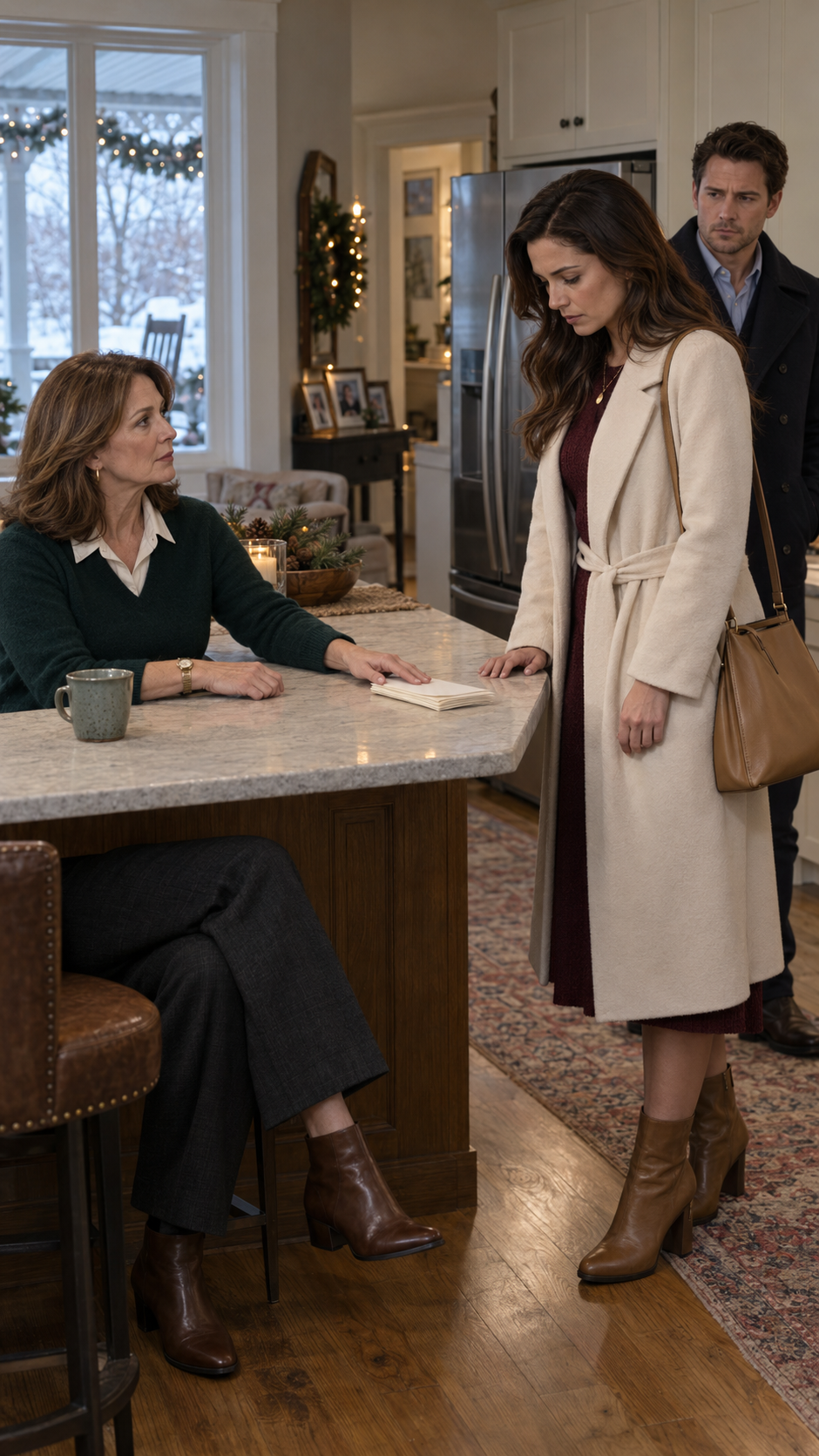
By the time they knocked, white Christmas lights glowed along the kitchen window. A wreath hung crookedly on the hallway mirror. Martin’s old Christmas record played softly from the speaker, all brass bells and velvet voices.
Harper came in first, wearing a cream wool coat and a polished little smile.
Alex followed behind her with his hands buried in his pockets.
My son looked tired.
Not grieving tired.
Not work tired.
He looked like a man who had been carrying something heavy and had not decided where to put it down.
“I know this is emotional for you,” Harper said.
I stayed seated at the kitchen island.
Then I laid the first document before them.
The mountain rental agreement.
My name. My credit card.
Next came the catering invoice.
The florist.
The wine delivery.
The transportation company.
The photographer.
Finally, I placed the payment summary in front of Alex.
He bent over it.
His face changed before he finished reading.
“Mom,” he said quietly. “Is this right?”
“Eleven thousand six hundred and forty dollars.”
The kitchen went still.
Harper’s smile flickered.
“This really isn’t necessary.”
“No,” I said. “What wasn’t necessary was banning me from a Christmas I was paying for.”
“You can’t just cancel everything,” she snapped.
“I already did.”
Alex turned toward her.
“You told me your parents were paying half.”
Harper froze.
“They were planning to contribute,” she said.
“Planning?” His voice dropped. “You said they already paid.”
My phone buzzed against the counter.
I glanced down.
It was a text from my sister Linda.
Harper told everyone you canceled Christmas because you were having a breakdown. Is that true?
I read it twice.
Then I turned the dark phone screen toward Harper.
The color drained from her face.
Alex took the phone from my hand. His jaw tightened as he read the message.
“Breakdown?” he asked.
“That’s not what I said,” Harper answered too quickly.
Not, *I never said that.*
Just, *that’s not what I said.*
And suddenly I saw the trap for what it was.
If I cried, I was unstable.
If I protested, I was dramatic.
If I canceled a Christmas I had paid for, Harper could point at the empty rental house and call it proof that I had become irrational.
She had not simply excluded me.
She had prepared a story about why I deserved to be excluded.
Alex stared at his wife.
“Who else did you tell?”
Harper swallowed.
Her right hand slipped into the pocket of her cream coat.
Then stopped.
I noticed the movement because it was too deliberate.
Because her fingers curled around something.
Something she did not want us to see.
“What’s in your pocket?” I asked.
“Nothing.”
“Harper,” Alex said, “what’s in your pocket?”
Her eyes flicked to him, then to me.
For the first time since arriving, she looked frightened.
Not embarrassed.
Not guilty.
Frightened.
“I don’t have to show you anything,” she said.
“You’re in my house,” I replied. “And you came here to discuss my mental health.”
“I came here because you’re acting exactly the way I said you would.”
“Then show us what you brought.”
Her mouth trembled.
Alex stepped forward, not touching her, but close enough that she could no longer pretend she had control of the room.
“Harper.”
For a moment, I thought she would run.
Then, with a sharp breath, she pulled a thick white envelope from her pocket.
It had my name written across the front.
ELEANOR BLAKE.
My full legal name.
The name only banks, doctors, and funeral homes used.
I did not open it immediately.
I looked at my son.
“Did you know about this?”
“No,” he said.
His answer came fast.
Too fast.
But I was not ready to understand that yet.
I opened the envelope.
The first page was a petition for emergency conservatorship.
I read the words twice because my brain refused to make sense of them.
Petition for Temporary Guardianship of Eleanor Blake.
The petitioner was Harper.
The reason listed beneath it made my chest turn cold.
The respondent has demonstrated escalating emotional instability, impaired financial judgment, suspicious behavior toward family members, and a recent pattern of paranoia.
Below that was a paragraph describing me as “verbally aggressive,” “socially isolated,” and “unable to make responsible decisions regarding personal finances.”
There were witness statements.
My sister Linda.
My neighbor Carl.
A woman from my book club.
Even the name of my primary physician appeared in a section titled *Supporting Documentation*.
My fingers shook as I turned the page.
Then I saw it.
A printed photograph of me standing in my front yard two weeks earlier, wearing my robe and yelling at someone through the doorway.
The caption beneath it read:
Respondent experiencing a public emotional episode.
I remembered that morning.
A delivery driver had dropped a heavy box of frozen food on my porch, then driven away without ringing the bell. The box sat there for nearly an hour in the snow. I had shouted after his van because the turkey was thawing.
That was it.
That was the “episode.”
“Oh my God,” Alex whispered.
Harper’s chin lifted.
“You don’t understand,” she said. “She needs help.”
I looked at her.
Really looked.
At the elegant coat. The perfect hair. The pale gold earrings I had given her last Christmas because she had cried and told me she had never had a mother who welcomed her.
“You told people I was having a breakdown,” I said.
“You have been different since Martin died.”
“My husband died.”
“You’re obsessed with money.”
“You are holding a legal petition to take control of my money.”
Her face hardened.
“I’m trying to protect this family.”
“No,” I said. “You are trying to remove me from it.”
Alex took the papers from my hands and flipped through them, page after page.
His breathing changed.
“Linda signed this?” he said.
“She was worried.”
“My Aunt Linda lives three states away.”
“She said you’d been upset on the phone.”
“She worries if I sneeze twice.”
Harper stared at him.
“You said she was getting worse.”
The words landed strangely.
Not because of what Harper said.
Because of the way Alex went still afterward.
“You said what?” I asked.
His eyes met mine.
And for one terrible second, I saw something move behind them.
Not confusion.
Not betrayal.
Recognition.
Then his face closed again.
“I said you were sad,” he told Harper. “That’s not the same thing.”
But it was too late.
A small piece of the room had shifted.
A wall had cracked.
I noticed Harper’s hand creeping once more toward her coat pocket.
“Give me your phone,” I said.
She laughed nervously. “Absolutely not.”
“Then leave.”
“I’m not leaving until we talk about this.”
“You have brought paperwork designed to strip me of my independence. You lied to my family. You lied to my son. You lied about who paid for Christmas. You will either give me the phone or you will leave my house, and I will call the police.”
“Mom,” Alex said, “let’s not—”
“No.”
I stood.
I had not raised my voice.
I did not need to.
For months after Martin died, everyone had spoken to me gently, carefully, as if grief had turned me into glass.
But I was not glass.
I was the woman who had sat beside a hospital bed for eleven days while my husband’s heart failed. I was the woman who had signed the hospice forms, chosen the coffin, answered the door to casseroles, and slept alone for the first time in forty-two years.
I was broken once. That did not mean I was breakable forever.
“Give me the phone,” I said again.
Harper looked at Alex.
He did not look back at her.
Finally, she pulled the phone from her pocket and placed it on the counter.
It was not her normal phone.
It was smaller. Older. Cheap.
A burner.
My stomach dropped.
Alex picked it up before I could.
The screen lit under his thumb.
There were dozens of messages.
Some were from my sister Linda.
Some from a number saved as CARL NEXT DOOR.
Some were screenshots of private family chats.
Then Alex stopped scrolling.
His face became bloodless.
“What?” I asked.
He did not answer.
I took the phone from him.
At the top of the screen was a message thread with one contact.
No name.
Only a gray circle with the letter A.
The most recent message had been sent that morning.
She’ll cancel everything. Let her. It proves she’s impulsive.
Below it:
Tell Linda she’s unraveling. She’ll spread it faster than anyone.
Below that:
Do not mention the trust yet. Not until the petition is filed.
I stared at the words until they blurred.
Harper made a sound behind me.
A strangled, helpless sound.
“Tell her,” I said.
She shook her head.
“Tell me whose number this is.”
“It isn’t—”
“Tell me.”
Her eyes filled with tears.
Then she whispered, “Alex’s.”
The room vanished.
Not literally.
But in the way a room disappears when your mind can no longer accept what it is seeing.
I turned slowly toward my son.
He stood beside the island, pale and motionless.
His phone was in his coat pocket.
The same pocket where his hand had been since he walked inside.
“No,” I said.
It was not an accusation.
It was a plea.
Alex closed his eyes.
“Mom—”
“No.”
“I can explain.”
“You wrote those messages.”
His silence answered.
Harper gave a bitter laugh through tears.
“Now you want to explain?”
Alex snapped toward her. “You don’t get to act innocent.”
“I’m not innocent,” she said. “But this was your idea.”
He looked at me again.
And the expression on his face was so raw, so terrified, that a part of me still wanted to protect him.
That was the cruelest thing of all.
Even then.
Even after seeing the messages.
A mother’s love does not disappear when her child betrays her. It simply becomes another wound.
“Why?” I asked.
Alex looked down at the papers.
“The trust,” he said.
“What trust?”
He swallowed.
“Dad’s trust.”
Martin had been a careful man. A quiet man. A man who labeled the spare batteries and kept tax returns in color-coded folders. After he died, our lawyer had explained that his life insurance and investments had been placed in a family trust.
I had assumed Alex knew the details.
Apparently, he knew more than I did.
“Dad left the house in trust,” Alex said. “You have lifetime use of it. But when you die, it goes to the grandchildren.”
“Yes.”
“You can’t sell it. You can’t borrow against it. You can’t change it.”
“No.”
His eyes filled.
“I’m in debt, Mom.”
Harper looked at him with open hatred.
“Tell her the whole thing.”
Alex’s jaw clenched.
“I made some bad investments.”
“How much?” I asked.
He did not answer.
“How much?”
“Four hundred and eighty thousand.”
The number seemed absurd.
Almost funny.
My son had once cried because he lost a five-dollar bill at the county fair.
Now he stood in my kitchen telling me he had lost nearly half a million dollars.
“Where?” I whispered.
“Crypto. A restaurant deal. Then loans. I kept trying to fix it.”
“And you thought declaring me incompetent would fix it?”
“No,” he said quickly. “I thought if Harper became your guardian, she could sell the house—”
“The house is not mine to sell.”
“She could petition to modify the trust.”
“She couldn’t.”
“I know that now.”
I laughed.
It came out as a cracked, ugly sound.
“You know that now?”
Harper wiped her cheeks with the heel of her hand.
“He knew from the beginning,” she said.
Alex turned on her. “Stop.”
“No. You promised me I wouldn’t take the fall for this.”
“You won’t if you stop talking.”
She stared at him.
Then something in her face changed.
The last of her fear disappeared.
In its place came fury.
“You told me your mother was losing her mind,” Harper said to me. “You told me she was spending recklessly. You told me she had forgotten your birthday, forgotten Lily’s recital, forgotten things she hadn’t forgotten.”
I looked at Alex.
“I forgot your birthday?”
He said nothing.
“You said she didn’t know what day it was,” Harper continued. “You said she walked into walls. You said you were scared she’d hurt herself.”
“I never said that,” I whispered.
“I know,” Harper said.
Her voice broke.
“I know now.”
She reached into her coat pocket again.
This time, Alex lunged forward.
But Harper was faster.
She pulled out something I had not seen before.
A tiny black digital recorder.
My heart stopped.
“What is that?” I asked.
Harper pressed a button.
Static crackled.
Then Alex’s voice filled my kitchen.
Clear.
Cold.
Unmistakable.
“You need her upset on Christmas. Not hysterical. Just emotional enough. If she cancels the rental, it’s proof she’s making destructive financial decisions.”
A pause.
Then Harper’s voice, frightened and uncertain.
“Alex, this is wrong.”
His answer came next.
“You want your kids to have a future? Then stop acting like this is about her feelings.”
The recording clicked off.
No one moved.
Outside, snow fell in slow, heavy flakes.
Inside, Martin’s Christmas record reached the end of a song and began to skip.
Alex stared at the recorder.
His face had collapsed.
The performance was over.
The loving son.
The confused husband.
The shocked man betrayed by his wife.
All of it had been a costume.
And I understood the real reason Harper had frozen when I saw the envelope.
She had not been afraid I would discover her plan.
She had been afraid Alex would discover she had recorded him.
“I was going to stop,” Harper said, her voice shaking. “I swear to God, Eleanor. I was going to stop. But he said if I walked away, he’d tell everyone I forged the paperwork myself. He said I’d lose the kids.”
“You helped him,” I said.
“Yes.”
“You lied about me.”
“Yes.”
“You told my grandchildren their grandmother was unstable.”
Harper crumpled into one of the kitchen chairs.
“Yes.”
The silence that followed was unbearable.
Then I walked to the hallway.
Martin’s armchair sat beside the tree, empty as always.
For months, I had hated that chair.
I had hated its emptiness.
I had hated what it reminded me of.
But now I rested my hand against its worn leather arm and let myself remember what Martin once told Alex when he was sixteen and had broken a neighbor’s window.
*“Being sorry matters,” Martin had said. “But it doesn’t erase the glass.”*
I turned back.
“Alex,” I said.
He lifted his eyes.
“I am calling the police.”
His lips parted.
“Mom, please.”
“I will tell them everything. I will give them the recorder. The petition. The messages. You will have a lawyer. Harper will have a lawyer. And your children will be protected from both of you until someone decides what comes next.”
He began to cry.
Not quietly.
Not beautifully.
He cried like a man who had finally reached the edge of the lie he had built and found nothing beneath it.
“I’m your son,” he said.
“Yes,” I answered.
“That has not changed.”
His shoulders shook.
“And you’re still my mother.”
“Yes.”
“Then how can you do this?”
I looked at him for a long time.
Then I said the hardest thing I had ever said in my life.
“Because I am your mother.”
—
Christmas morning came six days later.
The mountain house sat empty.
The catered dinner had gone to a homeless shelter after the company agreed to redirect the food. The florist donated the centerpieces to the children’s wing of St. Mary’s Hospital. The photographer refunded half her fee and sent the rest to a domestic-violence charity when she learned the truth.
Harper moved out of Alex’s house with the children and went to stay with her sister.
She had been charged too.
But she gave a full statement.
So did Linda, who sobbed over the phone and begged me to forgive her for believing the lie.
“I wanted to help,” she said.
“I know,” I told her.
And I did.
That was the tragedy of Harper’s story. She had chosen the people most likely to love me and turned their love into evidence against me.
But lies are greedy things.
They eat until there is nothing left—not even the liar.
On Christmas morning, Emma, Noah, and Lily came to my house with a social worker, Harper’s sister, and more caution than children should ever have to carry.
They stood in my doorway in their coats.
Emma looked older than she had a week earlier.
Noah stared at the floor.
Lily clutched a stuffed rabbit under one arm.
“Grandma?” she said.
“Yes, sweetheart?”
“Mommy said you weren’t sick.”
I knelt in front of her.
“I’m not sick.”
“Daddy said you were.”
My throat closed.
Behind her, Emma began to cry.
“He said you didn’t want us anymore,” she whispered.
I pulled all three of them into my arms.
Their coats were cold from the snow. Their cheeks were wet. Noah smelled like bubblegum toothpaste.
And for the first time since that phone call, I cried too.
Not because Christmas had been ruined.
Not because my son had betrayed me.
But because children should never have to wonder whether they are wanted.
“Listen to me,” I said, holding their faces between my hands. “There is nothing in this world you could do that would make me stop loving you. Nothing. Do you understand?”
Lily nodded.
Noah nodded.
Emma threw her arms around my neck again.
Behind us, the tree lights glowed.
Martin’s chair waited in the corner.
And beneath the tree were three gift bags tied with gold ribbon.
Emma’s cinnamon popcorn.
Noah’s tagless shirts.
Lily’s purple pajamas.
The Christmas Harper tried to take from me was gone.
But the love she tried to erase was still here.
And this time, it belonged to the people who had earned it.
THE END