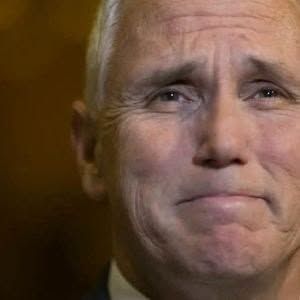
For a man whose entire public existence had been a masterclass in stoicism, the moment of collapse was as jarring as a thunderclap in a clear sky. Mike Pence had long been the human equivalent of a fortress, a figure defined by an unshakable, almost preternatural calm that shielded him from the volatile winds of American politics. He was the man who never cracked, the leader who wore his composure like a suit of impenetrable armor, and the servant who prioritized the machinery of the state above the turbulence of the soul. But as he stood before the flickering blue light of the television cameras on a night that would be etched into history, the fortress crumbled. The nation watched in a state of suspended animation as the practiced cadence of his voice began to fray at the edges, catching on a jagged breath that signaled the end of an era. The mask, held in place by decades of discipline, finally slipped, revealing a face ravaged by the heavy, silent toll of a life spent in the service of power.
This was not the polished, focus-grouped resignation the pundits had predicted. There were no clever euphemisms about spending more time with family to hide a political defeat, nor was there the defiant spin of a man looking to preserve his place in the history books. Instead, it was a raw, agonizing surrender to the truth. It was a public confession that the price of leadership had finally become a debt he could no longer pay without losing the last remnants of himself. For years, he had operated under the fundamental belief that endurance was the ultimate virtue—that a leader must absorb every crisis, every insult, and every betrayal without flinching. He had accepted the late nights in the West Wing, the endless briefings, and the suffocating weight of being fundamentally misunderstood by both his allies and his enemies as the necessary tax of his station. What he had failed to anticipate was how the relentless grind of the political machine would hollow him out from the inside, stripping away his humanity one compromise at a time until the man in the mirror was a total stranger.
The cameras had been his constant companions, serving as both the witnesses to his rise and the bars of his gilded cage. They had documented every rehearsed smile and every perfectly timed nod, yet they were blind to the profound, bone-deep exhaustion that settled over him the moment the studio lights were cut. He existed in a hyper-visible world where any hint of vulnerability was viewed as blood in the water, a fatal weakness that would be exploited by the relentless cycle of news and noise. Silence had been his only defense, a tactical retreat into a shell of duty that kept the public at bay but also kept his own spirit isolated. As he stood at that mahogany podium, however, the gravity of those lost years finally overwhelmed the architecture of his pride. The realization that he had sacrificed the vibrant colors of a real life for the gray, sterile corridors of influence hit him with the force of a physical blow, and for the first time, he let the world see him bleed.
In admitting that the cost of his career had grown too high, he shattered the most sacred and unspoken commandment of the political elite: never show your heart. To admit that the pressure was too much or that the soul was weary was to commit professional suicide in a town that worships strength. Yet, in that jarring rupture of his persona, something remarkably soft and undeniably human began to emerge from the wreckage. By choosing to walk away at the height of his influence, he was not just quitting a job; he was recalibrating his entire internal compass. He was signaling a definitive shift in how he measured the worth of a man’s life. No longer would his success be dictated by electoral maps, legislative wins, or the fickle approval of the morning headlines. Instead, he began to tally his remaining days in the currency of the small, vital things he had discarded along the way: the quiet dinners at home, the birthdays that had been celebrated through a phone screen, and the long-overdue conversations with the people who had loved him long before he had a title.
The act of walking away did not serve as a magical eraser for the past. It did not scrub away the controversies that had defined his tenure, nor did it offer a rewrite of the historical record that would surely scrutinize his every move. The damage of the political area is often permanent, leaving scars that no amount of solitude can fully heal. However, his departure opened a narrow, honest, and perhaps final path toward a different kind of victory: personal repair. This was a choice made in the quiet chambers of the conscience, far removed from the consultants and the strategists. For the inner circle of friends and family who had waited with infinite patience for the man they once knew to return from the dark abyss of national politics, this wasn’t a defeat. It was a resurrection. It was the moment the public figure died so that the human being could finally live.
The silence that blanketed the country following his announcement was profound and heavy. It wasn’t the usual partisan silence of shock or the tactical quiet of an opposition party preparing a response. It was a collective pause, a moment where a divided nation was forced to witness a man reclaiming his lost dignity in real-time. He had traded the deafening roar of the crowd and the intoxicating lure of the high office for the quiet, sacred sanctuary of a life reclaimed. He proved that even after a lifetime of navigating the murky waters of compromise and political necessity, there remains a pivotal moment where a person can simply stop. They can turn around, face the wreckage of their own making, and choose to be real.
As he stepped away from the microphone, the air in the room seemed to change. The tension that had defined his presence for years evaporated, replaced by a somber peace that transcended the bitterness of the era. He walked off the stage not as a casualty of the system, but as a survivor of it. The journey ahead would be quiet, filled with the slow work of reconnecting with his roots and tending to the relationships he had allowed to wither in the shadow of his ambition. The world would continue to turn, the headlines would find new targets, and the machinery of power would quickly find a replacement to fill the void he left behind. But for Mike Pence, the race was over. He had finally found the courage to stop running toward greatness and start walking toward home, leaving behind a legacy that was defined not by what he gained, but by what he was finally willing to give up in order to find his soul.