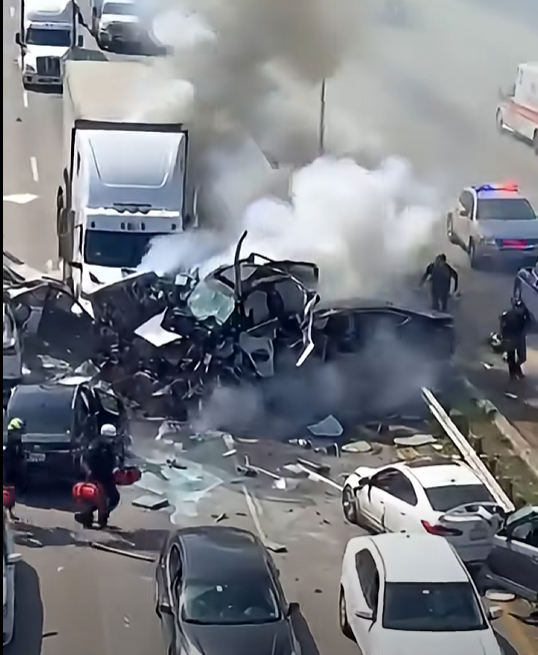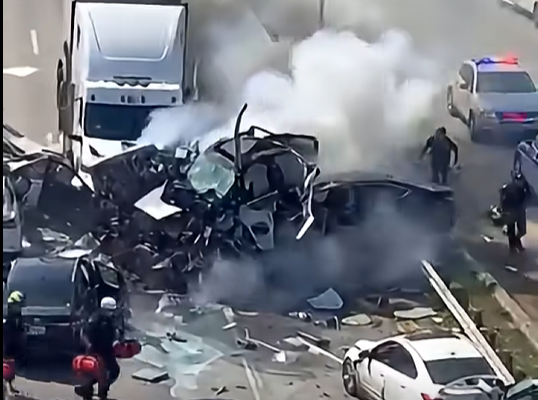
A serious multiple-vehicle accident on the Mexico–Querétaro Highway caused major disruption and concern Wednesday after a trailer reportedly lost control and crashed into several vehicles near Huehuetoca in the State of Mexico. The incident unfolded along one of the country’s busiest transportation corridors, temporarily paralyzing traffic and leaving drivers stranded as emergency crews rushed to the scene.
According to preliminary reports, the crash occurred around kilometer 059+000 of the highway during difficult weather conditions caused by steady rainfall throughout the day. Authorities stated that a large trailer traveling toward Mexico City was unable to stop in time near the Jorobas intersection, leading to a chain-reaction collision involving multiple vehicles.
Witnesses described moments of panic as the heavy truck allegedly veered out of control before slamming into a retaining bank and crashing into at least five cars and a pickup truck. The impact reportedly forced the trailer across all three north-to-south lanes, effectively blocking much of the roadway and creating immediate traffic chaos.
Motorists nearby said the situation developed extremely quickly.
Drivers traveling behind the trailer reportedly attempted sudden evasive maneuvers while others became trapped in backed-up traffic with little room to escape. Some witnesses described hearing loud impacts echo across the highway moments before vehicles came to a stop amid scattered debris and damaged guardrails.
Rain and wet pavement may have played a major role in the accident.
Although investigators have not yet officially determined the exact cause, authorities indicated that slippery road conditions likely contributed to the driver’s inability to brake effectively. Heavy vehicles such as trailers require significantly longer stopping distances under normal conditions, and wet highways can dramatically reduce tire traction and vehicle control.
Transportation safety experts frequently warn that highways become especially dangerous during rainstorms because drivers often underestimate how quickly conditions change.
Water accumulating on roads can reduce friction between tires and pavement, increasing the likelihood of skidding or hydroplaning. Large commercial vehicles face additional challenges because of their weight, braking distance, and reduced maneuverability during sudden emergencies.
Even experienced drivers can lose control if speed, weather, and traffic conditions align unfavorably.
Emergency response teams, including paramedics and highway personnel, arrived rapidly after the crash to assess injuries and secure the area. Several people involved in the collision reportedly sustained minor injuries ranging from bruises and cuts to neck and back pain caused by the impact.
Fortunately, no fatalities or life-threatening injuries were immediately reported.
Paramedics treated injured passengers and drivers at the scene, though medical teams reportedly advised some individuals to seek further hospital evaluation as a precaution. In many highway accidents, symptoms such as internal injuries, whiplash, or concussions may not fully appear until hours after the collision.
Authorities emphasized the importance of medical follow-up even when injuries initially appear minor.
The emotional atmosphere following the accident reflected both shock and relief. Drivers who escaped serious harm described the terrifying realization of seeing a large trailer lose control ahead of them with little time to react.
For many motorists, the experience likely became a reminder of how suddenly ordinary travel can transform into a dangerous situation.
Meanwhile, the accident caused significant traffic disruption throughout the region.
Because the trailer ended up blocking all three north-south lanes, authorities implemented partial highway closures while emergency crews worked to remove damaged vehicles and clear debris. Traffic congestion stretched for long distances as stranded motorists waited for lanes to reopen gradually.
Some drivers reportedly remained stuck for hours.
Major accidents on heavily traveled highways often create ripple effects extending far beyond the immediate crash site. Commercial deliveries, commuters, public transportation schedules, and emergency response routes can all become disrupted simultaneously.
The Mexico–Querétaro Highway serves as one of the country’s key transportation arteries, connecting major industrial and urban regions. High traffic volume, combined with heavy cargo transport, means even temporary closures can create extensive delays affecting thousands of travelers.
Road safety experts note that accidents involving trailers or cargo trucks tend to attract heightened concern because of the potential severity of impacts involving large commercial vehicles.
Fully loaded trailers carry enormous momentum, particularly at highway speeds. When braking systems fail, visibility becomes limited, or weather conditions worsen, collisions involving heavy trucks can escalate rapidly.
Investigators will likely examine several factors while reconstructing the incident.
These may include:
Vehicle speed
Road conditions
Brake system performance
Driver reaction time
Visibility
Mechanical condition of the trailer
Traffic flow at the time of the crash
Weather data from the area
Authorities generally conduct careful reviews after serious commercial vehicle accidents to determine whether human error, mechanical failure, environmental conditions, or multiple combined factors contributed to the collision.
The incident also renews broader discussions about highway safety during adverse weather.
Transportation officials consistently urge drivers to reduce speed during rainstorms, increase following distance, avoid sudden braking, and remain especially cautious around large trucks. Many accidents occur because drivers continue traveling at normal highway speeds despite reduced traction and visibility.
Safety campaigns often emphasize that wet roads can be deceptively dangerous even when rainfall appears moderate.
The first rainfall after dry periods can be particularly hazardous because oil and debris accumulated on pavement rise to the surface, creating slippery conditions.
For truck drivers, managing braking distance becomes especially critical.
Commercial vehicles require far more space to stop safely than passenger cars. Under wet conditions, stopping distances can increase dramatically, leaving little margin for avoiding sudden obstacles or traffic slowdowns.
Beyond the physical damage and traffic delays, accidents like this also leave psychological effects on those involved.
Even minor collisions can create lasting anxiety for drivers and passengers, particularly when large vehicles are involved. Some individuals experience fear returning to highways afterward, while others replay the moment repeatedly in their minds.
That emotional reality is often overlooked once traffic resumes and damaged vehicles are removed.
But for those who lived through the incident, the memory can remain vivid long after headlines fade.
Fortunately, in this case, the outcome could have been far worse.
Despite the scale of the crash and the number of vehicles involved, authorities reported only minor injuries rather than fatalities or catastrophic trauma. Emergency responders, medical personnel, and highway crews helped prevent further danger while managing an extremely challenging scene.
As investigations continue, officials are expected to review all available evidence to better understand exactly what happened near Huehuetoca that rainy Wednesday afternoon.
For many drivers watching the aftermath unfold, however, the accident already reinforced a sobering lesson that highways repeatedly teach:
A single moment of lost control—especially under dangerous weather conditions—can change countless lives within seconds.