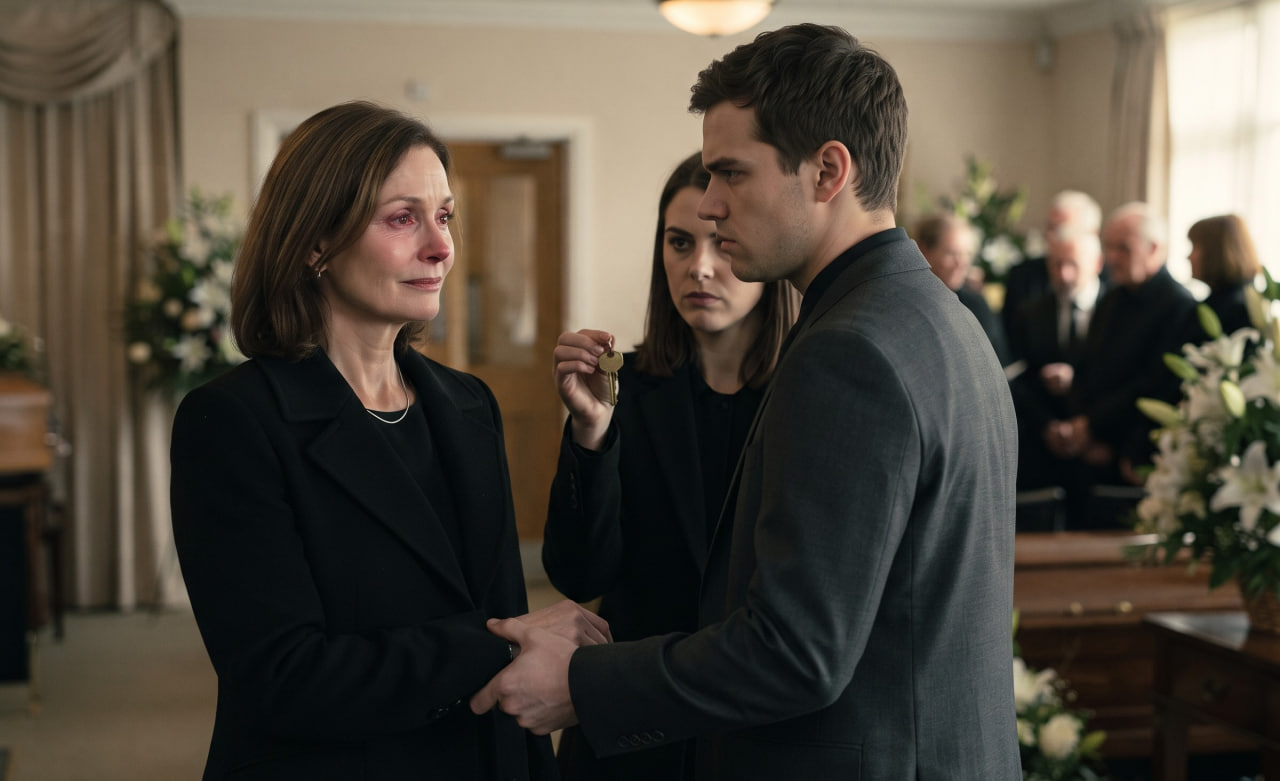
My fingers closed around it.
Too late.
Because from the hallway outside Mr. Katz’s office came three slow knocks.
Everyone froze.
Knock.
Knock.
Knock.
Mr. Katz looked toward the door.
“Did you invite anyone?”
“No.”
The handle turned.
The door opened.
And the woman from the funeral stepped inside.
Margaret.
She looked at me.
Then at the brass key in my hand.
Her face changed.
“You found it,” she whispered.
I stood.
“What happened on October 14, 1997?”
Margaret closed the door behind her.
Then she looked at Roy.
Then Sandra.
And finally at me.
“Arthur told you the truth about the pills,” she said.
“But he didn’t tell you why they were changed.”
My stomach dropped.
“Why?”
She stepped closer.
“Because your husband wasn’t trying to save himself.”
She looked toward the two children.
“He was trying to save you.”
Roy whispered, “Mom…”
Margaret turned toward him.
“You still call me that?”
Roy’s face crumpled.
And then Margaret said the words that made the room go completely silent:
“Arthur didn’t cause the fire.”
“He didn’t kill anyone.”
“He took the blame.”
She looked at me.
“And the person he was protecting that night…”
Her eyes filled with tears.
“Was Helen.”
For a moment, I could not understand her.
“Me?”
Margaret nodded.
“Yes, Helen. You.”
Roy lowered his head.
Sandra began crying again.
Mr. Katz quietly closed the door.
No one spoke.
Margaret came closer and sat across from me.
“You were only nineteen,” she said. “You don’t remember because Arthur made sure you wouldn’t have to.”
I shook my head.
“I never knew you.”
“You knew my daughter.”
“Claire?”
Margaret smiled through her tears.
“Claire was your friend.”
Something inside me shifted.
A memory surfaced.
A girl with dark hair.
A red scarf.
Rain.
A bus stop.
A voice saying, Don’t tell anyone where I’m going.
I pressed my fingers against my forehead.
“Oh my God.”
Margaret nodded.
“Claire discovered what Arthur’s business partner was doing. Money was disappearing. People were being threatened. Arthur found out and tried to stop it.”
“And the fire?”
“Was meant for Arthur.”
She looked at Roy and Sandra.
“But Arthur wasn’t the only person in danger.”
Mr. Katz opened another folder.
“Claire had evidence,” he said. “She gave it to Helen.”
I stared at him.
“I don’t remember.”
“You weren’t supposed to.”
Arthur had arranged everything.
The night of the fire, he had taken the evidence from me and told me to forget Claire’s name.
Then he made a choice that changed all our lives.
He let everyone believe he had caused the fire.
He accepted the blame because the real people responsible had threatened Helen.
Margaret had disappeared to protect Claire.
Arthur had disappeared into another life.
And years later, when he met me in the hospital, he recognized me immediately.
He had spent nine years making sure the danger never found me again.
I began to cry.
Not because I was angry.
Because suddenly every strange thing Arthur had ever done made sense.
The monthly lawyer visits.
The shoebox.
The secret recordings.
The way he always told me not to worry.
The way he never allowed me to travel alone after dark.
The way he looked at the front door whenever someone knocked.
I whispered:
“You could have told me.”
Margaret reached across the table.
“He wanted to.”
She smiled sadly.
“But he loved you more than he loved being understood.”
Roy finally spoke.
“Dad knew about the pills.”
“Yes.”
“I didn’t change them.”
Margaret looked at him.
“I know.”
Roy began to cry.
“I knew Sandra was doing something, but I didn’t know what.”
Sandra covered her face.
“I only wanted him to sign the papers.”
I turned toward her.
“You gave him the wrong medication.”
“I was desperate.”
“You could have killed him.”
“I know.”
Her voice broke.
“I know.”
Mr. Katz stood.
“And that is why Arthur documented everything.”
He opened the last folder.
Inside were copies of medical records, pharmacy records, photographs, recordings, and signed statements.
But there was one final document.
A letter addressed to me.
I opened it.
My beloved Helen,
If you have reached this page, then the worst part is over.
I wish I could be there to see your face.
I know you will be angry.
You have every right.
But please don’t spend the rest of your life being angry with the people who hurt us.
I didn’t.
I spent mine loving you.
That is the part I want you to remember.
The house is yours.
Not because I gave it to you.
Because you made it a home.
The money is yours.
Not because you married me.
Because you stood beside me when I had nothing left to give.
And the truth belongs to everyone.
So let it go where it needs to go.
I stopped reading.
The tears were falling freely now.
At the bottom, he had written:
Friday was never about the house.
It was about giving you your life back.
I pressed the letter against my heart.
For the first time since Arthur died, I smiled.
It hurt.
But it was a real smile.
Three Months Later
The house remained mine.
The trust held.
Roy and Sandra were required to return everything they had taken, including the silver Sandra had hidden in her basement.
The medication records were turned over to the authorities.
There was an investigation.
There were difficult conversations.
There were apologies.
Some wounds did not close quickly.
But they began to heal.
Roy came to the house one Saturday morning carrying a toolbox.
“I fixed the porch,” he said.
I looked at him.
“You don’t have to.”
“I know.”
He put the toolbox down.
“I want to.”
We stood there awkwardly.
Then he said:
“I was a terrible son.”
I didn’t argue.
He laughed sadly.
“I guess I deserved that.”
“You deserved honesty.”
He nodded.
“I’d like to start there.”
So we did.
Sandra came the following week.
She returned the silver herself.
She cried when she placed it on the dining-room table.
“I thought Daddy loved us less because he loved you.”
I shook my head.
“He loved all of you.”
“Then why did it feel like he chose you?”
“Because I stayed.”
She looked at me.
And I said the thing Arthur had taught me without ever saying it directly:
“Love isn’t always about who gets chosen.”
“Sometimes it’s about who stays when there is nothing left to gain.”
Sandra cried.
I hugged her.
It wasn’t forgiveness all at once.
It was simply a beginning.
One Year Later
On the first Tuesday of the month, I still drove downtown.
But I no longer drove to Mr. Katz’s office.
I drove to the little park beside the river.
I carried flowers.
Sometimes Margaret came with me.
Sometimes Roy and Sandra came too.
We had discovered something strange about grief.
It didn’t disappear.
It changed shape.
Arthur’s chair remained by the window.
His books remained on the shelves.
His old coat still hung behind the kitchen door.
But the house no longer felt haunted by his absence.
It felt filled with him.
One evening, I found the shoebox in the attic.
I opened it.
Twenty-two envelopes.
All empty now.
Except one.
The very last envelope.
I had never opened it.
There was no date.
Only my name.
I sat on the floor and opened it.
Inside was a photograph.
Arthur and me.
Young.
Laughing.
Standing in front of the house.
On the back, Arthur had written:
If you found this, then you survived the mystery.
Now stop looking backward.
Go live.
I laughed through my tears.
“Bossy old man.”
From downstairs, I heard a knock.
I went down.
It was Roy.
He held a paper bag.
“Dinner,” he said.
Sandra stood behind him.
“She burned the first one.”
“I did not.”
“You did.”
“I overcooked it.”
I smiled.
For nine years, I had been called the nurse.
For nine years, they had treated me like a woman who had taken something that belonged to their family.
But Arthur had known the truth.
I hadn’t stolen a family.
I had built one.
A strange one.
A wounded one.
An imperfect one.
But ours.
That night, we ate together around the same table where Arthur had once hidden his secrets.
Nobody talked about inheritance.
Nobody talked about the house.
Nobody talked about money.
We talked about ordinary things.
Dinner.
The weather.
The garden.
A movie Sandra wanted us to watch.
And for the first time, I understood the final gift Arthur had left me.
Not the house.
Not the money.
Not even the truth.
Peace.
After everyone left, I stood alone in the kitchen.
The radio played softly.
The same kind of music that had been playing the morning Arthur died.
I looked toward his chair.
For just a second, I imagined him sitting there.
Smiling.
Waiting for me to ask another question.
I whispered:
“I kept my promise.”
The house was silent.
Then the old clock on the wall struck ten.
I smiled.
“Goodnight, Arthur.”
And this time, when I turned off the light, I wasn’t afraid of the darkness.
Because there were no more secrets waiting inside it.
Only memories.
Only love.
And tomorrow.
My tomorrow.
The one Arthur had spent nine years quietly protecting.
And at last—
I was free to live it.
THE END

One Comment on “At My Husband’s Funeral, His Son Said, “Pack a Bag—This House Goes to Real Family.” I Told Him, “Wait for Friday.””