Observe the lines on your hand, it reveals the secret of your life and future…viết thành bài k gen ảnh mà
The Secret of Your Thumb: Can Your Hand Really Reveal Whether You Will Become Rich or Poor?
Article Description
Can the shape of your thumb reveal your financial future? Viral images circulating online claim that a simple line near the base of the thumb can distinguish wealthy people from those destined to struggle financially. This idea comes from the ancient practice of palmistry, which assigns symbolic meanings to the lines and shapes of the hand. But is there any truth behind these claims? Discover what traditional palmistry says about thumb lines, what science actually tells us, and which factors truly influence financial success.
Chapter 1: The Mysterious Thumb Line That Has Everyone Talking
Have you ever looked at the lines on your hand and wondered whether they might reveal something about your future? Across social media, images claiming to distinguish rich people from poor people based on the shape of a thumb line have attracted considerable attention.
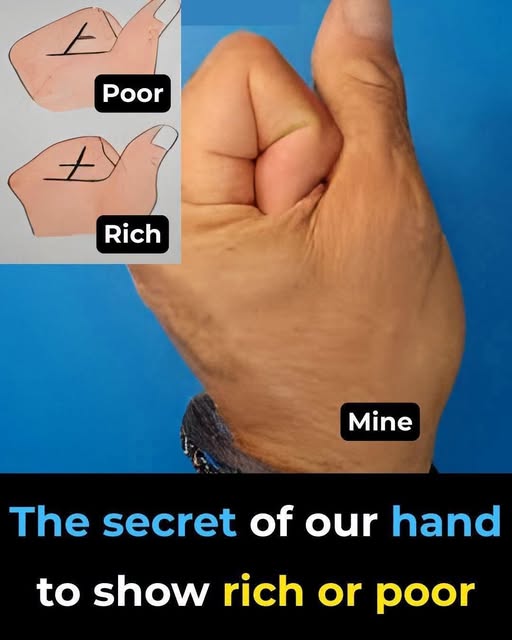
The idea appears simple. One illustration shows a particular line labeled “poor,” while another shows a different pattern labeled “rich.” Viewers are encouraged to compare these examples with their own hands and decide which category they supposedly belong to.
For people curious about fortune-telling, the claim can be intriguing. Wealth is something many people hope to achieve, and the possibility of discovering clues about financial success through a simple physical feature naturally attracts attention.
This belief is associated with palmistry, a traditional practice in which the lines, shapes, and other characteristics of the hand are interpreted as symbols of personality or possible life experiences.
In some palmistry traditions, the area around the base of the thumb is associated with vitality, affection, determination, and material well-being. Certain creases may be interpreted as favorable signs, while others are assigned less positive meanings.
However, these interpretations are not consistent across all traditions, and there is no scientifically established system for determining a person’s wealth from the shape of their thumb.
A person’s hand develops through a combination of genetics, anatomy, and natural movement. The creases that form around the thumb help the skin fold as the hand bends and grips objects.
There is no reliable evidence that these creases determine future income, career opportunities, or financial stability.
Although the viral image presents an entertaining idea, it is important to separate traditional beliefs from verifiable facts. Examining your thumb may satisfy your curiosity, but it cannot tell you whether you will become rich or poor.
Chapter 2: What Palmistry Says About the Shape of Your Thumb
In traditional palmistry, different parts of the hand are assigned symbolic meanings. The fleshy area at the base of the thumb is often called the Mount of Venus, which is associated with affection, vitality, enthusiasm, and emotional energy.
Palm readers may examine the shape of this area, the prominence of its surface, and the creases that cross it. Depending on the tradition, these features may be interpreted as indicators of personality traits or possible life experiences.
The thumb itself is also assigned symbolic significance. Some palmistry systems associate a strong or well-proportioned thumb with determination, independence, or willpower. Other interpretations focus on flexibility, length, or the angle at which the thumb extends from the hand.
The viral rich-versus-poor comparison applies this type of symbolic thinking to financial prospects. It suggests that a clear, prominent line may indicate prosperity, while a faint or differently shaped line could represent financial difficulties.
However, there is no universally accepted palmistry interpretation for this particular mark. Different practitioners may give the same line different meanings, making the claim difficult to evaluate consistently.
It is also important to recognize that palmistry is a cultural and historical practice rather than a scientifically validated forecasting method. Its interpretations may be interesting to explore, but they should not be treated as objective assessments of someone’s abilities or future.
A person with a particular thumb crease may become a successful entrepreneur, an employee, an artist, or a professional in another field. Another person with an apparently identical crease may follow a completely different path.
Their outcomes depend on many influences that cannot be read from the skin of the hand.
For those who enjoy traditional fortune-telling, palmistry can remain an entertaining way to explore cultural beliefs. The important thing is not to allow a symbolic interpretation to create unnecessary fear or unrealistic expectations about financial success.
Chapter 3: What Science Reveals About the Lines on Your Hand
The lines on the human hand are natural skin creases that develop during fetal growth and help the skin fold when the fingers and thumb move.
Their appearance varies from person to person. Genetics, hand anatomy, and the way skin folds around joints all contribute to individual differences.
These lines can sometimes have medical relevance. For example, some people have a single transverse crease across the palm, a feature that can occur in healthy individuals but is also associated with certain developmental conditions. Even in medicine, however, a crease alone cannot establish a diagnosis.
This illustrates the difference between observing a physical characteristic and claiming that it predicts an unrelated life outcome.
There is no credible scientific evidence that the shape of a thumb line can reliably predict wealth, income, intelligence, career success, or a person’s ability to accumulate money.
To establish that such a relationship exists, researchers would need to define the thumb patterns precisely, measure financial outcomes objectively, and demonstrate that the patterns predict those outcomes consistently across different populations.
A prediction would also need to perform better than ordinary explanations such as education, employment, family circumstances, and access to financial resources.
Palmistry has not demonstrated that level of predictive reliability.
Why, then, do some people believe that hand-reading works?
One explanation is confirmation bias, the tendency to notice information that supports an existing belief while overlooking information that contradicts it. If someone receives a positive prediction and later experiences financial success, they may remember the prediction as remarkably accurate.
Another factor is the use of broad statements that can fit many different situations. A prediction about future prosperity might be interpreted as successful whether someone becomes wealthy quickly or experiences gradual improvements over several decades.
These psychological tendencies can make fortune-telling seem more convincing than the available evidence supports.
Ultimately, the lines on your hand can tell us something about anatomy, but they have not been shown to reveal your financial destiny.
Chapter 4: The Real Factors That Influence Whether You Become Wealthy
Financial success is rarely determined by one characteristic or decision. It develops through a combination of personal choices, economic circumstances, available resources, and opportunities over time.
Education and practical skills can influence employment options and earning potential. People who develop valuable skills and continue learning may be better prepared to adapt when industries change or new opportunities arise.
Financial habits also matter. Creating a budget, monitoring expenses, avoiding unnecessary high-interest debt, and building emergency savings can improve financial resilience. Over time, these habits may help people manage unexpected expenses and work toward longer-term goals.
For those who can afford to invest, a suitable investment strategy may contribute to wealth accumulation. However, investments involve risk, and decisions should be based on financial goals, time horizons, and individual circumstances rather than promises of guaranteed returns.
Consistency is often more useful than searching for a shortcut. Setting realistic goals, reviewing spending regularly, and making informed decisions can help people build greater financial stability.
Nevertheless, it would be inaccurate to suggest that wealth depends entirely on individual effort. Family background, access to education, health, caregiving responsibilities, discrimination, economic conditions, and unexpected emergencies can significantly affect a person’s opportunities.
Two people who work equally hard may experience very different financial outcomes because they face different circumstances.
Recognizing these realities does not mean personal decisions are unimportant. It means financial success should be understood in a broader context rather than reduced to a single personality trait or physical feature.
Instead of examining your thumb for signs of future prosperity, consider the financial information you can actually measure. Review your income, essential expenses, debts, savings, and financial goals.
Identify practical improvements that fit your circumstances. These might include developing a marketable skill, reducing an unnecessary expense, building an emergency fund, or seeking qualified financial guidance.
None of these steps guarantees wealth, but they address factors that can genuinely influence financial well-being.
Your future is not determined by a line on your hand. It is shaped by a complex interaction of personal decisions, opportunities, resources, and circumstances.
Chapter 5: Should You Believe That Your Thumb Can Predict Your Future?
The popularity of palmistry reflects a common human desire to understand what lies ahead. Questions about money, relationships, career success, and personal happiness can be difficult to answer, making simple explanations particularly appealing.
A picture that promises to reveal financial destiny through a thumb crease offers an immediate answer to a complicated question. It encourages people to compare themselves with a visual example and imagine that their future may already be written into their hands.
However, an appealing explanation is not necessarily an accurate one.
There is no reliable scientific basis for concluding that a particular thumb line means someone will become wealthy or remain poor. People with similar hand patterns can have very different careers, incomes, family circumstances, and financial outcomes.
Believing these claims too literally can create unnecessary anxiety. Someone whose thumb supposedly indicates poverty may feel discouraged, while another person may assume that wealth is guaranteed and overlook the importance of planning.
Neither conclusion is justified.
If you enjoy palmistry, you can explore it as a cultural tradition or a form of entertainment. But it should not be used to make major decisions about investments, employment, relationships, or other important aspects of life.
A more useful approach is to focus on what you can assess and influence. Develop your skills, understand your finances, seek reliable information, and make decisions that reflect your goals and circumstances.
It is equally important to recognize that financial well-being is not the only measure of a successful life. Health, supportive relationships, personal freedom, and the ability to meet essential needs all contribute to a fulfilling future.
The bottom line: The belief that a thumb line can reveal whether you will become rich or poor comes from traditional palmistry, not established science. Your hand’s creases do not determine your financial destiny. Your opportunities, circumstances, decisions, and access to resources matter far more than any mark on your thumb.