My name is Margaret, though everyone calls me Maggie.
I’m seventy-two, and I raised three children in Denver.
Jennifer. Michael. Lisa.
For most of my life, being their mother was the center of everything.
I packed lunches, drove carpools, made Halloween costumes, sat through baseball games and dance recitals, helped with homework, broken hearts, broken bones, and every crisis that seemed enormous when they were young.
After my husband, Richard, died at fifty-nine, my children surrounded me at his funeral and promised I would never be alone.
For a while, I believed them.
Then the visits became monthly.
Then holidays only.
Eventually, I became the person always making the call.
“Just wanted to hear your voice.”
“Maybe next week, Mom.”
“I’m swamped.”
“Can’t talk right now.”
I kept making excuses for them.
Jennifer had a demanding job in corporate communications.
Michael ran a small contracting company.
Lisa had two children and taught elementary school.
People get busy.
Children grow up.
A mother should not expect to remain the center of adult lives.
I repeated those truths until they became excuses for something else.
I was lonely.
Not because my children had independent lives.
Because I was always the one reaching across the distance.
The morning everything changed, I woke with chest pain.
At seventy-one, with Richard’s fatal heart attack burned into my memory, I genuinely thought I might be dying.
I called 911.
The hospital kept me overnight.
I called Jennifer.
Voicemail.
Two hours later, she texted.
OMG, Mom. So glad you’re okay. Crazy day at work.
She never called.
Michael responded six hours later.
Glad you’re fine. Get some rest.
Lisa waited until the next day.
Not one of them came.
I took an Uber home alone.
The doctors had not found a heart attack. They believed the pain came from severe reflux combined with anxiety, but they wanted follow-up.
I was relieved.
I was also changed.
The hospital scare showed me the difference between believing I had support and actually having it.
In the weeks afterward, I started noticing what happened when my children did contact me.
Jennifer asked about Richard’s life insurance.
Michael wanted to know whether I had organized my estate.
Lisa kept suggesting I sell my house and move into a senior community.
My house was worth nearly nine hundred thousand dollars.
My savings and investments totaled another six hundred thousand.
There was also a two-hundred-fifty-thousand-dollar life insurance policy Richard had left, now invested rather than sitting as cash.
Suddenly, conversations about my “future” sounded suspiciously like conversations about numbers.
Still, I wanted to believe I was wrong.
So I called all three of them and asked one simple question.
“If something serious happens to me, can I count on you?”
Jennifer sighed.
“Mom, please don’t start this again.”
Michael became irritated.
“We have our own lives.”
Then I reminded them about the hospital.
“You didn’t even call me.”
“We texted,” Lisa said.
“I was scared.”
Michael finally snapped.
“Mom, stop calling us every time you feel lonely or scared. We have our own lives. You’re healthy. You have money. Figure it out yourself.”
I sat in my kitchen after that call and cried harder than I had since Richard died.
Then the tears stopped.
Not because I stopped loving my children.
Because something became clear.
I had organized my entire future around assumptions nobody had agreed to.
I assumed one of them would help after surgery.
I assumed they would visit if I became frail.
I assumed someone would manage bills if I became incapacitated.
I assumed family love automatically created a care plan.
It did not.
The following morning, I called Thomas Brennan, the attorney who had handled Richard’s estate.
“I need to make some changes.”
He did not say:
Cut them all out.
He said:
“Tell me what changed.”
I did.
Then he asked questions I should have answered years earlier.
Who held my financial power of attorney?
Jennifer.
Who was my backup?
Michael.
Who could make medical decisions if I could not?
Jennifer first, then Lisa.
Had I discussed those roles with them recently?
No.
Did I believe they would actually serve?
I did not know.
That uncertainty mattered more than anger.
Over the next three weeks, Thomas and I reviewed everything.
My will.
My investments.
My house.
Beneficiary designations.
Medical directives.
Powers of attorney.
Every account my children assumed would someday become theirs.
I changed some beneficiaries.
I changed the estate structure.
I replaced financial decision-makers with a professional fiduciary and a trusted longtime friend as backup after confirming both were willing.
I kept family members in limited medical roles only where I believed the arrangement was workable, with clearer backups.
I added direct provisions for grandchildren and charitable gifts.
I did not give every dollar away in rage.
I built a plan around what I actually wanted.
Then I changed every lock, every entry code, and every password connected to my property.
The locks were not part of the estate plan.
They were part of another boundary.
My children still used old codes from when they were younger.
They entered without calling.
That had once felt like family.
Now it felt like access I had never reconsidered.
I installed cameras and a security gate after a neighborhood burglary pushed me to upgrade the property anyway.
For three months, my children did not call.
Neither did I.
The silence hurt.
It also taught me something.
My phone still worked when I stopped chasing them.
The relationship did not.
Then, two weeks before Christmas, Jennifer suddenly phoned.
“We’re all coming to your place for Christmas. Like old times.”
All three children.
Their spouses.
The grandchildren.
They had not visited in more than a year.
“Why now?” I asked.
Her cheerful voice disappeared.
“We’re worried about you. We think it’s time to discuss your future and maybe transitioning to somewhere more manageable.”
There it was.
The house.
Again.
“I don’t want you here,” I said.
Jennifer laughed as if I were joking.
“We’ll be there on the twenty-third.”
“No.”
I hung up.
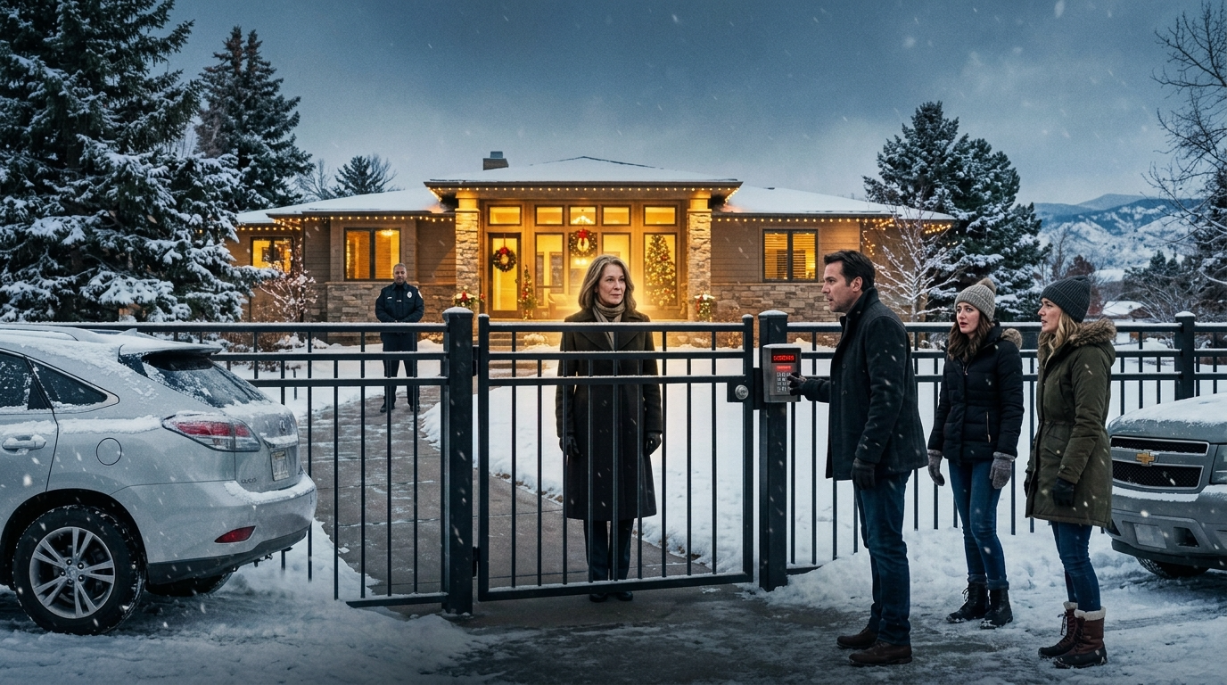
On December twenty-third, my phone alerted me at exactly two in the afternoon.
Vehicle at front gate.
I opened the security camera.
Three cars.
Jennifer’s SUV.
Michael’s truck.
Lisa’s sedan.
Michael walked directly to the keypad and entered the old code.
Denied.
He tried again.
Denied.
Then Jennifer pressed the intercom.
“Mom, open the gate.”
I looked at my three children standing outside the home they had already begun discussing as if it were their future property.
“No,” I said.
For several seconds, nobody moved.
Then Michael grabbed the metal gate and started climbing.
That was when a man stepped into view behind him.
“Sir, get down from that gate immediately.”
My children turned.
The security officer I had hired for the holiday week looked toward the camera, then asked me one simple question.
“Ma’am, these people are not on the authorized list. Would you like me to remove them from the property?”
I looked at my three children through the screen.
Three months earlier, I would have worried about embarrassing them.
I would have opened the gate.
I would have apologized.
That woman was gone.
“Yes,” I said. “Please ask them to leave.”
The first meeting with Thomas lasted almost three hours because he kept asking questions I had never separated before.
“What is the purpose of your money?”
I laughed.
“To exist?”
“No. Your money has jobs. What are they?”
I had never thought of it that way.
Housing.
Health care.
Emergency reserves.
Travel.
Support for grandchildren if I chose.
Charitable giving.
Then inheritance, if anything remained.
That order embarrassed me because inheritance had quietly moved too high in my mind. I had spent years treating money I still owned as if I were merely storing it for the next generation.
Thomas also reviewed every beneficiary designation separately because wills do not control everything. Retirement accounts, payable-on-death accounts, insurance, trusts, and jointly titled property can pass under different rules.
“Do not assume changing the will changes all of this,” he said.
That was exactly why I needed a professional instead of a dramatic handwritten note telling my children they would regret ignoring me.
We also discussed incapacity.
I had always feared death more than disability because of Richard’s sudden heart attack. But Thomas asked what would happen if I were alive and temporarily unable to manage bills.
Jennifer had once been the obvious choice.
Now I did not know whether she would even answer a call.
That uncertainty did not make her a bad daughter.
It made her a bad plan.
Plans should not rely on hoping someone becomes available.
So I identified a licensed professional fiduciary, Karen Moss, and met her before naming her.
She explained fees, duties, reporting, and limits.
I almost rejected the idea because paying someone to manage my own affairs if I became incapacitated felt impersonal.
Then she said:
“Professional does not mean family is excluded. It means somebody has a defined job.”
That made sense.
My children could still visit, advocate, ask questions, and love me.
They would not have to become accountants by default.
By the time I left Thomas’s office that first day, I felt tired but strangely calm.
I had not punished anyone.
I had replaced assumptions with named responsibilities.
That was far more powerful than revenge.
One of the documents Thomas asked me to review was my old letter of instruction—the informal note that sat beside the legal documents and told Jennifer where to find things. It had been written years earlier in Richard’s handwriting at the top: Maggie hates paperwork, so make this simple.
I laughed when I saw it.
Richard had always believed I disliked paperwork. In truth, I disliked paperwork when someone else made all the choices and handed me forms at the end.
Now I wanted to understand every page.
Thomas walked me through the difference between a will, a trust, a power of attorney, and an advance medical directive. He explained what each could and could not do.
I asked too many questions.
He answered all of them.
That meeting changed something deeper than my estate.
For years, I had let Richard handle several financial tasks because he was better at them. After he died, I learned enough to keep things running, but I still treated expertise as something other people possessed.
At seventy-two, I decided no one should understand my own plan better than I did.
That did not mean doing everything alone.
It meant knowing what I was delegating and why.
The difference between dependence and delegation became one of the clearest lessons of my later life.
The first time I saw the revised estate summary, I felt guilty.
Not because the plan was wrong.
Because the numbers beside my children’s names were no longer the largest numbers on the page.
Thomas noticed my face.
“You are allowed to revise this again later.”
“I know.”
“Then why do you look like you’re being sentenced?”
I laughed.
“Because mothers are supposed to give.”
He shook his head.
“Parents give during life in many ways. An estate plan is not a final exam in motherhood.”
That sentence became one of the most useful things anyone said to me. I had raised three children, helped with education, weddings, emergencies, and grandchildren. None of that created a legal or moral requirement that every remaining dollar flow directly back to them.
Once I understood that, the plan stopped feeling like punishment and started feeling like allocation.
I also changed one thing that had nothing to do with money. I removed the old emergency contact card from my refrigerator. It listed Jennifer first, Michael second, Lisa third, as if birth order automatically created availability.
I replaced it with actual current contacts: my physician, building security, Karen the fiduciary, Jennifer for medical matters, and backups in the order we had discussed.
That little card captured the larger change. I stopped organizing reality around tradition and started organizing it around who had agreed to do what.
Family could still be part of the plan. It no longer had to be the whole plan.
I changed passwords slowly rather than all at once because I wanted to avoid locking myself out of accounts. Elena helped me build a secure list and confirm recovery methods. That practical step mattered more than the dramatic idea of “cutting everyone off.”
Security should make life safer, not create new chaos. I learned to separate symbolic actions from useful ones. A new password was useful because it reflected current access. A furious mass message announcing that I had changed everything would only have created more conflict.
The most important thing Thomas did was refuse to let me use legal documents as emotional messages. If I wanted my children to know I was hurt, he told me to say it while alive. If I wanted to protect assets and define authority, that belonged in the documents. Separating those purposes kept the plan cleaner and my relationships more honest.
I also asked Thomas to explain every fee. He smiled and did. Transparency mattered to me now. I no longer wanted to sign things because someone competent said they were standard. Understanding was part of ownership. That habit stayed with me through every later move, care contract, and estate update.
By the end of that first month, I had a folder labeled MY PLAN instead of CHILDREN. That title seemed trivial. It was not. The documents were about my life, not a rehearsal for their inheritance. Every later decision became easier once I kept that perspective.
Michael climbed down slowly.
Jennifer stared directly into the camera.
Mom, are you serious?”
“Yes.”
“We drove all this way.”
“I told you not to come.”
Lisa held up her phone.
“Are you recording us?”
“The gate camera records automatically.”
“That is insane.”
No.
Showing up after being told no and then climbing a gate was closer to insane.
The security officer remained calm.
“Folks, the homeowner has asked you to leave.”
Michael threw his hands up.
“She’s our mother.”
The officer answered:
“That does not make this public property.”
That sentence became legendary in my head.
Jennifer moved closer to the intercom.
“Mom, the kids are in the cars.”
That hurt.
My grandchildren had nothing to do with the argument.
I loved them.
I almost opened the gate because of them.
Then I recognized what was happening.
The children had been brought to a visit I explicitly declined.
Their presence could not become leverage.
“I’m sorry the kids were brought into this,” I said. “Take them somewhere warm. This is not happening today.”
Jennifer’s face hardened.
“You’ve changed.”
“Yes.”
For once, I did not hear that as an insult.
They left after several minutes of argument.
Michael kicked gravel near the truck.
Lisa kept filming.
Jennifer cried.
I cried too once the cars disappeared.
The security officer asked whether I was all right.
“No.”
That answer felt freeing.
A boundary can be necessary and still hurt.
I called Thomas the next morning.
Not because rejecting a Christmas visit was a legal event.
Because I wanted to review whether any documents needed updating after the confrontation.
He said:
“Before we talk estate planning, are you safe?”
“Yes.”
“Good. Then tell me what you want the documents to accomplish.”
That question prevented me from doing something foolish.
Part of me wanted to disinherit all three children completely.
Not because that had been my lifelong intention.
Because I was angry.
Thomas said:
“An estate plan should reflect durable values, not the emotional temperature of one week.”
So we reviewed the plan again.
I did reduce what my adult children would receive directly compared with the old will.
I increased direct provisions for the grandchildren through age-appropriate trusts.
I designated charities Richard and I had supported for years.
I created instructions for professional administration so none of my children would control another’s inheritance.
I set aside resources for my own future care first.
That was the most important change.
The previous plan treated my assets almost as a future inheritance waiting to happen.
The new plan treated them as resources for my life.
Housing.
Health care.
Travel.
Support services.
Long-term care if needed.
Whatever remained later could pass according to the plan.
I did not owe my children a fixed number at death.
That realization changed how I viewed money.
I also met with a certified financial planner named Elena Park.
She ran retirement projections.
“Your biggest risk is not spending too much on lunch,” she said. “It’s assuming you won’t need expensive care later.”
We modeled home care, assisted living, market downturns, and longevity.
For the first time, I had a plan that did not require one of my children to become my unpaid caregiver.
That did not mean I rejected family help if offered.
It meant I would not build my safety on an unspoken obligation.
Two days after Christmas, Lisa texted.
The kids don’t understand why Grandma wouldn’t let them in.
My first reaction was guilt.
Then anger.
Then I wrote carefully:
Please tell them Grandma loves them. The adults had a disagreement, and I had already said I was not hosting Christmas. They are not responsible for fixing it.
Lisa did not reply.
A week later, Jennifer sent a long email accusing me of becoming paranoid about money.
She said they had only wanted to discuss downsizing because they cared.
Some of that might have been true.
Concern and financial interest can coexist.
I did not need to decide that every conversation about the house had been greedy.
I responded with one paragraph.
I am capable of managing my affairs. I have professional advice. I will ask for help when I want it. Do not arrive at my home without invitation.
Michael called from a new number.
I answered before recognizing it.
“Mom, this is ridiculous.”
“No.”
“We’re your family.”
“Yes.”
“You’re acting like we’re criminals.”
“I asked you not to come. You came. You climbed my gate.”
“I was trying to get your attention.”
“You had it through the intercom.”
Silence.
Then:
“So this is about money.”
One more thing mattered in this part of the story: progress was never one dramatic decision. It came from small choices repeated until they became normal. That pattern, more than any document or argument, was what changed our family over time.

One Comment on “The Day My Children Told Me to “Figure It Out Yourself,” I Stopped Begging for Their Attention and Started Protecting My Own Future”